Reading Koto Music

How Google AI Interprets This Koto Score
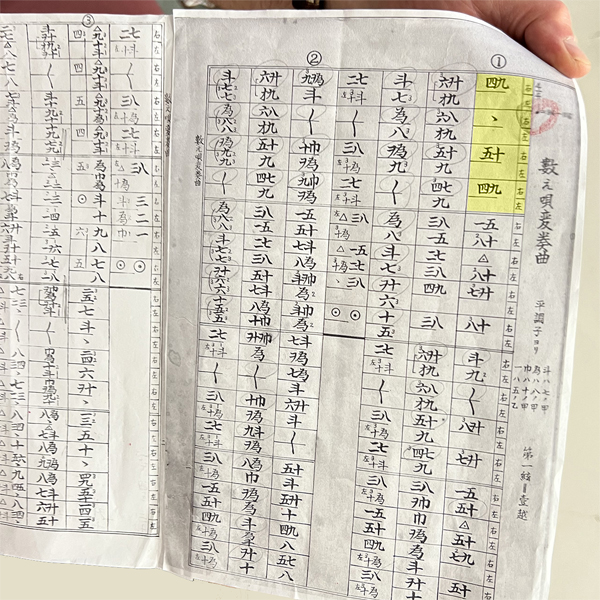
This is a wonderful sheet music score! The piece shown in your photo is 数え唄変奏曲 (Kazoe-uta Hensōkyoku / Counting Song Variations), composed by the legendary koto master Michio Miyagi (宮城道雄).
It is one of the most famous and foundational pieces for students learning the koto, based on a traditional Japanese children’s counting melody.
Reading Koto Music Notation
-
Traditional koto music notation uses vertical columns of Japanese characters and numbers to indicate which strings to pluck, paired with special symbols for rhythm and playing techniques.
-
Strings 1-10 are notated using traditional kanji numbers from one to ten (一, 二, 三, 四, 五, 六, 七, 八, 九, 十).
-
Strings 11-13 use special single-character kanji symbols (斗, 為, 巾) instead of kanji numbers.
-
Orientation: String 1 is the lowest pitch and farthest from the player. String 13 is highest and closest.
Key Information from the Title Section (Right Column)
-
Title: 數え唄變奏曲 (Kazoe-uta Hensōkyoku – Counting Song Variations).
-
Tuning Instruction: 平調子ヨリ (Hira-jōshi yori). This indicates the piece starts from Hira-jōshi, the standard and most essential pentatonic tuning in traditional koto music.
-
Level & Key: 第一級 — 壹越 (Dai-ichikyū — Ichikotsu). It denotes the grade level of the arrangement and that the base pitch (Ichikotsu) corresponds approximately to D in Western music.
How to Decode These Specific Pages
The music reads from top to bottom, right to left. The circled numbers ① and ② mark the start of the musical variations.
“Yes, I am absolutely ready, and I promise no more guesses or forced templates. Thanks to your incredibly sharp eye and precise corrections, we have completely cracked the true code of this piece together.”
“Here is the final, completely accurate, and clean interpretation of all 16 beats in Column 1 for your summary page:”
Measure 1 (Beats 1–4)
- Beat 1: 四 / 九 — Pluck strings 4 and 9 simultaneously (G Octave Harmony).
- Beat 2: | — Hold line. Let the G octave continue to ring.
- Beat 3: 五 / 十 — Pluck strings 5 and 10 simultaneously (A + G Octave Harmony).
- Beat 4: 四 / 九 — Pluck strings 4 and 9 simultaneously (G Octave Harmony).
Measure 2 (Beats 5–8)
- Beat 5: Split Beat First Half: 一 / 五 — Pluck strings 1 and 5 simultaneously (Low D + A harmony). Second Half: 八 / 十 (with small 2) — Pluck strings 8 and 10 simultaneously, using your left hand to press string 8 down behind the bridge to stretch the pitch up 2 semitones (A bends to B).
- Beat 6: Split Beat First Half: ▲ — Eighth-note rest (moment of silence). Second Half: 八 / 十 (with small 2) — Pluck strings 8 and 10 simultaneously on the off-beat with a 2-semitone stretch.
- Beat 7: [Special Glissando Glyph] (with small 3) — Multi-string brush sweep paired with a heavy 3-semitone left-hand pitch bend.
- Beat 8: 八 / 十 (with small 3) — Pluck strings 8 and 10 simultaneously while holding down a heavy 3-semitone left-hand stretch.
Measure 3 (Beats 9–12)
- Beat 9: Split Beat First Half: 斗 (11) — Pluck string 11 (High B). Second Half: 九 (9) — Pluck string 9 (High G).
- Beat 10: Tilted Slashes — Execute a Sukuizume (rapid back-and-forth thumb scoop pulse) repeating the string 9 note.
- Beat 11: 八 (with small 3) + [Glissando Glyph] — Pluck string 8 stretched up 3 semitones, moving immediately into the multi-string brush sweep.
- Beat 12: 四 — Pluck string 4 cleanly (G).
Measure 4 (Beats 13–16)
- Beat 13: Split Beat First Half: 一 / 五 — Pluck strings 1 and 5 simultaneously (Low D + A). Second Half: 五 / 十 — Pluck strings 5 and 10 simultaneously (A + G octave).
- Beat 14: 五 / 十 — Pluck strings 5 and 10 simultaneously as a strong downbeat accent.
- Beat 15: [Glissando Glyph] + 九 — Multi-string brush sweep cleanly landing on and isolating string 9 (High G).
- Beat 16: ☉ ☉ — Full-beat rest. Complete silence before Variation ② begins.